
How Businesses Can Use AI Safely to Work Smarter, Save Time, and Grow Faster
By jhen · June 23, 2026 · 4 min read
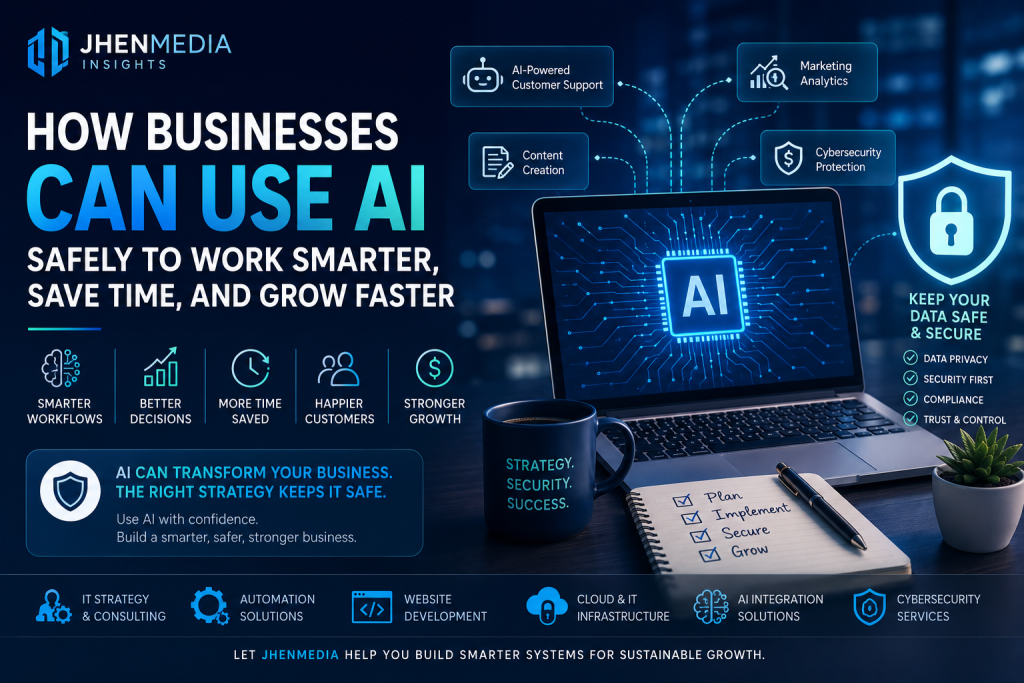
Artificial intelligence (AI) is no longer just for large corporations. Today, small businesses, startups, and growing brands are using AI tools to automate tasks, improve customer service, increase sales, and make better business decisions. But while AI creates major opportunities, it also introduces serious concerns around data security, privacy, and implementation.
At JHenMedia, we help businesses integrate AI solutions into their websites, workflows, and digital strategies in ways that are secure, scalable, and aligned with real business goals.
Why AI Matters for Business Growth
AI can improve efficiency across nearly every department of your business. Instead of replacing your team, AI acts as a force multiplier.
Some of the biggest benefits include:
- Faster customer support through AI chatbots
- Automated lead generation and qualification
- Personalized email marketing campaigns
- Better website SEO optimization
- Smarter inventory forecasting
- Faster content creation
- Enhanced data analysis for decision-making
Businesses that combine AI with a strong IT foundation often outperform competitors because they can move faster and scale more efficiently.
If your business is still relying on outdated systems, it may be time to review your IT infrastructure and automation strategy.
Related: Learn how our Website Development and IT Solutions can modernize your business systems.
Practical AI Use Cases for Small and Medium Businesses
1. AI Customer Support
AI-powered chatbots can answer common questions 24/7, reduce support tickets, and improve customer experience.
Use cases:
- Appointment booking
- Order status updates
- FAQ automation
- Lead qualification
This pairs well with JHenMedia’s business automation services for CRM integration and customer workflows.
2. AI Content Creation
Businesses use AI to create:
- Blog posts
- Product descriptions
- Email campaigns
- Social media captions
- Video scripts
Important tip: AI should assist your content strategy, not fully replace your voice.
For better results, combine AI-generated drafts with human editing and SEO optimization.
3. AI for Marketing Analytics
AI can analyze:
- Website traffic
- Customer behavior
- Ad performance
- Conversion trends
This helps identify what’s working and where money is being wasted.
A properly configured analytics dashboard can reveal opportunities you may be missing.
4. AI for Cybersecurity
Modern cybersecurity tools now use AI to:
- Detect unusual login activity
- Flag phishing attempts
- Identify malware patterns
- Monitor network threats
This is critical for businesses handling customer data, payment information, or internal documents.
The Biggest AI Challenges Businesses Face
While AI is powerful, it comes with risks.
Data Privacy Risks
Many AI tools process your data in the cloud. If sensitive business information is entered into unsecured AI systems, it could be stored, leaked, or used to train models.
Examples of risky data:
- Customer personal information
- Financial records
- Internal contracts
- Medical records
- Proprietary business strategies
Best practice:
Never input confidential data into public AI tools without understanding their privacy policy.
Security Concerns
Not all AI software is secure.
Questions to ask:
- Where is the data stored?
- Is it encrypted?
- Who has access?
- Does it meet compliance standards?
Businesses should implement strong access controls, secure APIs, and proper authentication.
JHenMedia helps businesses deploy secure cloud-based systems and private AI workflows.
Poor AI Implementation
Many businesses adopt AI without strategy.
Common mistakes:
- Automating broken workflows
- Using too many disconnected tools
- No employee training
- No cybersecurity review
- No ROI measurement
AI works best when it solves specific problems.
How to Keep AI Safe in Your Business
Here are practical steps:
1. Create an AI Usage Policy
Set rules for employees:
- What tools can be used
- What data can be entered
- Approval workflows
- Security standards
2. Use Private or Business-Grade AI Tools
Avoid free public tools for sensitive work.
Instead use:
- Private GPT environments
- API-based secure integrations
- Internal AI models
3. Secure Your Data
Implement:
- Encryption
- Cloud backups
- Role-based access
- Multi-factor authentication
- Endpoint security
4. Audit AI Outputs
AI makes mistakes.
Always verify:
- Facts
- Legal information
- Customer-facing content
- Financial data
5. Combine AI With Human Oversight
AI should improve decision-making, not fully control it.
Human review is still essential.
AI + IT Strategy = Long-Term Business Growth
AI without a proper IT strategy can create more problems than solutions.
A strong IT strategy includes:
- Secure hosting
- Reliable backups
- Cloud infrastructure
- Website optimization
- API integrations
- CRM systems
- Automation workflows
- Cybersecurity protocols
This is where businesses often need expert guidance.
At JHenMedia, we specialize in helping businesses integrate technology the right way — from web development and IT consulting to automation and AI-powered business solutions.
Final Thoughts
AI is changing how businesses operate, market, and grow. The companies that succeed will be the ones that adopt it strategically, securely, and with clear goals.
If you’re looking to implement AI into your business but want to do it safely, start with your foundation first.
Your website, systems, and data security must be ready.
Need help?
Explore our services:
- Website Development
- Managed IT Services
- Business Automation
- AI Integration Consulting
- Cybersecurity Solutions
Let JHenMedia help you build smarter systems for sustainable growth.
Want this for your business?
Let's turn these ideas into a working system.